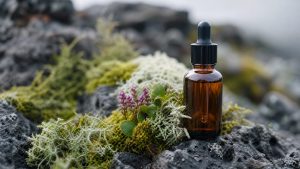
Volcanic soil, brutal cold, and thousands of years of evolutionary pressure — and why TARAMAR gets to harvest what that pressure produces.
Plants can’t run from a hard environment. They can’t migrate south for the winter or find shelter when the wind picks up. Whatever conditions they’re rooted in, they have to survive — and nowhere is that survival more demanding, or more chemically interesting, than at the edge of the Arctic.
- Life Is Tough Up Here — And That’s Exactly the Point
A herb growing in a Mediterranean hillside and a herb growing on an Icelandic lava field are, technically, often the same species. What they’ve lived through is nothing alike.
Icelandic plants work with a growing season measured in weeks, not months, squeezed between a late spring thaw and an early autumn frost. Within that narrow window they still have to germinate, grow, flower, and set seed — while contending with near-freezing nights even at the height of summer, relentless wind, and, paradoxically, some of the most intense and prolonged daily UV exposure a plant can experience, thanks to nearly round-the-clock daylight at high latitude. It’s a genuinely hostile combination: cold stress and light stress hitting at the same time, with almost no room for error before winter shuts the whole process down.
Seaweed faces its own version of the same problem, arguably an even harsher one. Intertidal species like the kelp and rockweed TARAMAR sources aren’t just cold-tolerant — they’re exposed to the air twice a day at low tide, meaning repeated cycles of drying out, temperature swings, and direct UV exposure that a fully submerged plant never has to deal with. Research on intertidal seaweeds has found that this cycle of exposure and stress is precisely what drives them to produce elevated levels of protective secondary metabolites — the same chemical defense strategy land plants use, adapted for a species that spends half its life underwater and half of it stranded in open air [1][2].
Neither of these organisms can just tough it out passively. To survive, they have to build a genuine internal defense system — and that system is chemical. - Their Defense System Is Our Ingredient List
Here’s the part that matters for skin: the compounds these plants and seaweeds build to protect themselves — phenolics, flavonoids, antioxidant enzymes, UV-screening pigments — are largely the same broad class of compounds that protect human skin cells from oxidative stress. When we go looking for powerful antioxidant ingredients, we are, in effect, looking for whatever a plant or seaweed had to build in order to survive its own worst days.
The research backs this up directly, not just as a nice metaphor. A 2023 study comparing yarrow (Achillea millefolium — the same species in TARAMAR’s Healing Treatment) collected from Turkey and from Lithuania found that phenolic compound content in the northern-latitude plant material was more than double that of the southern-latitude material [3]. Similar patterns have been documented in bilberry, where northern populations consistently show higher flavonoid and anthocyanin content than southern ones [4][5], and in a study of four vascular plant species from Svalbard — genuinely deep
Arctic conditions — where antioxidant capacity in every species tested actually exceeded that of the Trolox vitamin E reference standard used to benchmark it [6].
TARAMAR’s own published research tells the same story from the sea. Icelandic winged kelp (Alaria esculenta), tested by TARAMAR’s own founder and research team, showed 76.9% collagenase-inhibitory activity, 72.8% elastase-inhibitory activity, and the strongest antioxidant capacity of the three Icelandic seaweeds tested [7] — a direct, measured example of exactly the kind of defense chemistry a stressed, intertidal organism builds to survive. - What TARAMAR Gets to Work With
This is where the “extremely lucky” part comes in, and it’s worth saying plainly. TARAMAR doesn’t manufacture bioactivity in a lab from scratch. It harvests it — from herbs picked in the wild or grown on organic Icelandic farms, and from seaweed handpicked by Símon from the cold, clean waters of Breiðafjörður — material that has already spent thousands of years of evolutionary pressure perfecting its own defense chemistry, long before TARAMAR ever touched it.
Every plant TARAMAR uses is descended from generations that survived a genuinely difficult place. Angelica, yarrow, and calendula growing wild in Icelandic soil carry chemical defenses shaped by an entire evolutionary history of short seasons, brutal light exposure, and cold stress — not a few growing seasons under a greenhouse tarp. The same is true of the kelp pulled by hand from Breiðafjörður’s tidal flats, built over evolutionary time to survive being alternately drowned and exposed, frozen and sun-scorched, twice a day, every day.
TARAMAR’s role in that story is narrow and specific: harvest it carefully — by hand, without machines, without rushing the process — and preserve what’s already there using NoTox® rather than diluting or degrading it in the process. The plant and the seaweed already did the hard work. What arrives in the formula is simply what survived.
Sources
[1] Antioxidative and antimicrobial activities of intertidal seaweeds and possible effects of abiotic factors on these bioactivities. Journal of Oceanology and Limnology — found intertidal seaweeds generate protective secondary metabolites in response to repeated exposure and irradiance stress.
[2] Antioxidative Properties of Baltic Sea Keystone Macroalgae (Fucus vesiculosus) under Ocean Warming and Acidification in a Seasonally Varying Environment — documents oxidative stress response mechanisms in cold-water intertidal macroalgae.
[3] Trends in Phenolic Profiles of Achillea millefolium from Different Geographical Gradients — phenolic content in yarrow from northern-latitude populations (Lithuania) more than double that of southern-latitude populations (Turkey).
[4] Lätti, A.K., et al. (2008). Variation in anthocyanin content of Vaccinium myrtillus fruits in relation to geographical origin and latitude.
[5] Åkerström, A., et al. (2010). Effects of latitude-related environmental conditions on phenolic concentrations in bilberry (Vaccinium myrtillus L.) leaves.