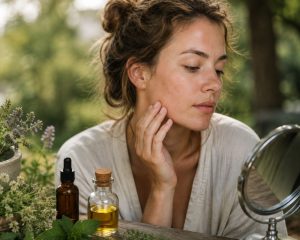
Why TARAMAR treats “food for the skin” as a literal standard, not a slogan.
“Clean” has become one of the most overused words in skincare, applied to products with wildly different actual formulations. Somewhere underneath the marketing, though, there’s a real question worth asking honestly: clean compared to what, exactly — and clean enough for what standard? TARAMAR’s answer is a specific and demanding one: a product should be safe enough that, in principle, you could eat it.
That’s not a rhetorical flourish. It’s a direct response to three separate, well-documented problems in conventional skincare — problems that don’t always show up on the same ingredient label, but that all point toward the same underlying issue.
The Well-Known Problem: Parabens
Parabens are probably the most publicly scrutinized preservative family in cosmetics, and the concern isn’t fringe science. Research has repeatedly found parabens detectable, intact, in human breast tumor tissue — one widely cited analysis found parabens present in 99% of the breast tumor samples it examined, with higher concentrations found in the upper-outer quadrant of the breast, the region closest to where underarm cosmetic products are typically applied [1][2]. Laboratory studies have shown that parabens can bind to estrogen receptors, mimicking the body’s own estrogen, and can stimulate the growth of estrogen-sensitive breast cancer cells in vitro [3][4].
It’s worth being precise about what this evidence does and doesn’t establish. The tumor-tissue studies are correlational, not proof of causation, and parabens’ estrogenic activity is, molecule for molecule, tens of thousands of times weaker than the body’s own estradiol [5]. Regulatory bodies have generally concluded that parabens, used at typical cosmetic concentrations, don’t measurably raise cancer risk on their own. But “weakly estrogenic” is not the same as “biologically inert,” and the fact that these compounds are showing up, unmetabolized, inside human tissue at all is exactly the kind of finding that should inform a genuinely cautious formulation philosophy — not be waved away because any single data point falls short of definitive proof.
The Less-Known Problem: Phenoxyethanol
Phenoxyethanol has become one of the most common paraben replacements in the “clean” beauty space, and it’s a good example of why replacing one preservative with another doesn’t automatically solve the underlying problem. In the EU, phenoxyethanol is permitted in cosmetics at concentrations up to 1% [6]. But that 1% figure isn’t a uniform safety consensus — it’s a compromise between differing regulatory positions. France’s national medicines safety agency has gone further, recommending a lower 0.4% limit for products used on children under three and advising against its use in the diaper area entirely, out of concern for infants’ capacity to process it [7][8]. Regulatory reviews have also noted that data on infant and neonatal exposure to phenoxyethanol specifically remains limited [9] — a real gap, not a settled question.
The EU’s 1% ceiling also addresses single-product exposure, not the cumulative reality of a typical routine: cleanser, serum, moisturizer, sunscreen, and makeup, each potentially containing phenoxyethanol at levels individually “within limits.” Nobody applies one cosmetic product a day. The regulatory math generally doesn’t add the products together.
The Overlooked Problem: What Hitches a Ride on “Natural”
Here’s the part that gets the least attention, and arguably matters the most: the label “natural” or “plant-derived” says nothing about what was sprayed on the plant before it was ever turned into an ingredient. Pesticides, fungicides, and herbicides used in conventional agriculture don’t stay in the field — they persist in the raw plant material and can travel straight through into the finished extract or oil. Laboratory screening of cosmetic products containing plant extracts has identified pesticide and fungicide residues even in products marketed as natural or certified organic, including compounds like carbendazim, a fungicide under scrutiny for suspected mutagenic effects [10][11][12]. A pharmaceutical and cosmetic-science review of essential oils and plant extracts specifically flagged that the monoculture farming techniques commonly used to grow raw material at commercial scale routinely involve pesticide classes now facing tightening regulation [13].
This is the blind spot in a lot of “clean” formulation: a brand can remove every synthetic preservative from its own formula and still be selling a product built on an ingredient that arrived pre-contaminated, because nobody checked what happened to the raw plant before it reached the lab. Clean formulation and clean sourcing are two different jobs, and skipping the second one quietly undoes the first.
Why This Matters More on Skin Than It Might Seem
There’s a specific pharmacological reason all of this deserves more caution on skin than the same exposure might get if it were, say, in food. When something is swallowed, it passes through the gut wall and then through the liver before it ever reaches general circulation — a checkpoint called first-pass metabolism, where the liver identifies and breaks down a substantial share of foreign compounds before they can spread through the body [14][15]. It’s precisely why some pharmaceutical drugs are deliberately delivered as skin patches instead of pills: applying a compound to skin bypasses that liver checkpoint entirely, letting it reach the bloodstream more directly and, in many cases, more completely [16][17].
Skin has some of its own metabolic enzyme activity, but it is nowhere near as extensive or well-characterized as liver metabolism [18]. In practical terms, that means a compound sitting in a daily-use lotion or serum doesn’t get the same first line of chemical defense that the same compound would face if it were eaten. The gut and liver, working together, are the body’s actual filtration system for foreign chemicals. Skin, by comparison, is a far more direct route in.
TARAMAR’s Standard: Food for the Skin
Put those three problems together — a preservative with a genuine, if contested, hormonal signal; a paraben alternative whose own regulators disagree on where the safe line sits; and raw “natural” ingredients that can carry agricultural chemistry nobody asked for — and the honest conclusion is that removing one flagged ingredient from a label doesn’t make a product clean. Clean has to mean the whole chain: what the plant grew in, what touched it before harvest, what preserves the formula once it’s bottled, and what’s actually capable of crossing into the body once it’s on skin.
That’s why TARAMAR holds its formulas to a standard closer to food safety than conventional cosmetic regulation: every input evaluated as though it might be ingested, not just applied. It’s the same logic running through NoTox®, TARAMAR’s preservation technology built specifically to avoid both parabens and phenoxyethanol, through TARAMAR’s sourcing from Icelandic growers working land essentially untouched by the pesticide drift and monoculture pressure common elsewhere, and through the “seed to skin” philosophy that treats ingredient control as starting at the farm, not the formulation bench.
Skin absorbs more than most people assume, and it does so with less of a safety net than the digestive system provides. A genuinely clean product has to be built for that reality — not just labeled around it.
Sources
[1] Barr, L., et al. (2012). Measurement of paraben concentrations in human breast tissue at serial locations across the breast from axilla to sternum. Journal of Applied Toxicology, 32(3), 219-232.
[2] Darbre, P.D., et al. (2004). Concentrations of parabens in human breast tumours. Journal of Applied Toxicology, 24, 5-13.
[3] Routledge, E.J., et al. (1998). Some alkyl hydroxy benzoate preservatives (parabens) are estrogenic. Toxicology and Applied Pharmacology, 153(1), 12-19.
[4] Byford, J.R., et al. (2002). Oestrogenic activity of parabens in MCF7 human breast cancer cells. Journal of Steroid Biochemistry and Molecular Biology, 80(1), 49-60.
[5] Toxicology and Applied Pharmacology (1998) – butylparaben estrogenic activity estimated at 10,000-100,000-fold weaker than endogenous estradiol.
[6] European Cosmetic Products Regulation (EC) No. 1223/2009; SCCS Opinion (2016) – phenoxyethanol permitted up to 1.0% in cosmetic formulations.
[7] ANSM (French National Agency for the Safety of Medicines and Health Products) – recommends a 0.4% limit for products intended for children under three and advises against use in the diaper area.
[8] CosmeticObs, “ANSM: a mandatory warning on leave-on cosmetics containing phenoxyethanol.”
[9] NAYA, “Is Phenoxyethanol Safe? What the Science Actually Says” – SCCS notes limited data on infant and neonatal exposure specifically.
[10] BAV-Institut, “Residues of pesticides in cosmetic products and raw materials.”
[11] Examination of Pesticide Residues in Cosmetic Product – fungicide residues (carbendazim, diethofencarb) detected in natural/organic-certified cosmetic samples.
[12] Cosmacon, “Pesticides – risks for cosmetics and health” – documents common pesticide/fungicide/herbicide classes found via plant-based raw materials.
[13] Use, analysis, and regulation of pesticides in natural extracts, essential oils, concretes, and absolutes. PubMed review.
[14] ScienceDirect Topics, “Skin Absorption” – overview of first-pass hepatic metabolism and its role in oral bioavailability.
[15] First Pass Effect – Wikipedia summary of hepatic portal metabolism following gastrointestinal absorption.
[16] Shaw, J.E., & Chandrasekaran, S.K. “Skin as a Mode for Systemic Drug Administration,” in Pharmacology of the Skin II (Springer-Verlag, 1989).
[17] Transdermal drug delivery – pharmacological overview of first-pass metabolism avoidance via skin administration.
TARAMAR INS T I TUT E™ — MAS T E R P LAN
[18] Skin Metabolism, Springer Nature – comparative overview of hepatic versus cutaneous xenobiotic-metabolizing enzyme activity.