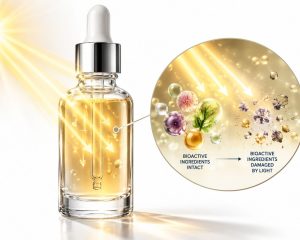
Sudden irritation, unexplained redness, dryness that won’t resolve, wrinkles that seem to appear overnight — and why the ingredient list is usually the first place to look.
A lot of people experience it the same confusing way: skin that was fine for years suddenly turns reactive. Redness that won’t calm down. Dryness that no amount of moisturizer seems to fix. Fine lines that appear faster than age alone would explain. It’s easy to assume this is just skin “changing,” or aging, or bad luck. In a great many cases, it isn’t. It’s a reaction to what’s actually in the products being used every day.
The Scale of the Problem Is Larger Than Most People Realize
This isn’t a fringe concern. Personal care products across the industry are formulated from a pool of more than 10,500 unique chemical ingredients, and a meaningful share of them are known or suspected carcinogens, reproductive toxicants, or endocrine disruptors [1]. The regulatory gap is stark: more than 40 countries — including the entire EU, UK, and a range of Southeast Asian nations — have restricted or banned over 1,300 chemicals from cosmetics, while the U.S. Food and Drug Administration has banned or restricted only about a dozen [2][3]. That’s not a small discrepancy. It reflects a genuinely different standard of caution applied to what’s allowed to touch skin.
The average person doesn’t experience this abstractly, either. Research indicates the average woman uses about 12 personal care products a day, comprising roughly 168 unique ingredients; the average man uses six products with about 85 ingredients [4]. Every one of those ingredients is a small, repeated, cumulative exposure — and very little regulatory oversight actually accounts for that cumulative reality.
Preservatives: The Most Common Offender
Nearly every conventional skincare product needs a preservative to prevent microbial growth, and the preservatives most widely used — parabens and, increasingly, phenoxyethanol — both carry genuine, documented concerns (see “What Makes Clean Skincare Truly Clean?”, elsewhere in this Part, for the full research on both). Formaldehyde and formaldehyde-releasing preservatives, along
with isothiazolinones, have historically been responsible for widespread allergic contact dermatitis, and while regulatory restrictions have reduced their prevalence, they remain in circulation in many markets [5]. These aren’t obscure or rare ingredients. They’re default choices across a huge share of the industry, precisely because they’re inexpensive and effective at their one job — preserving shelf life — with skin tolerance treated as a secondary concern.
Fragrance: A Well-Documented, Frequently Underestimated Cause
Fragrance deserves particular attention, because it’s both extremely common and poorly disclosed. More than 160 individual fragrance chemicals have been documented to cause contact allergy or allergic contact dermatitis [6]. Fragrance is second only to nickel as a cause of allergic contact dermatitis overall, and among patients patch-tested for suspected contact dermatitis, positive reactions to fragrance materials reach 20-25% in some clinical centers [6][7]. Personal-care-product-related dermatitis increased 2.7-fold in the United States between 1996 and 2016 [8] – a trend that lines up with an industry using more products, more ingredients, and more undisclosed fragrance compounds, not fewer.
The word “fragrance” on a label is itself part of the problem: it can legally represent dozens of individual chemicals bundled under one generic term, none of which the consumer can identify or avoid individually.
What Actually Works: Starting Over With Something You Trust Completely
When skin is reacting – genuinely reacting, not just adjusting to a new product – the most effective response usually isn’t finding a gentler version of the same category of ingredients. It’s removing all of it and replacing it with something formulated to a categorically different, higher standard (see “How to Care for Rosacea-Prone Skin, the TARAMAR Way,” Part VII, for how this plays out in practice). That’s a bigger ask than swapping one moisturizer for another. It’s also, based on what actually calms reactive skin, the approach that tends to work.
TARAMAR’s Standard: Food-Grade, Not Just “Clean”
This is the philosophy behind why TARAMAR treats “food-grade” as a literal formulation standard rather than a marketing description. Every raw material is evaluated the way a food ingredient would be – not just for what it can do for skin, but for whether it would be considered safe to ingest in the first place. That standard runs through TARAMAR’s food-grade extraction methods, developed in partnership with food science research (see Part XI), through NoTox® preservation technology built specifically to avoid parabens and phenoxyethanol rather than substitute one contested preservative for another, and through sourcing from Icelandic growers working land free of the pesticide pressure that contaminates so much conventional “natural” raw material (see Part VIII).
We decided, from the outset, to build a company people could actually trust with what goes on their skin every day – not a company competing on which synthetic ingredients to phase out slowest. That means a simple, non-negotiable rule: TARAMAR will never include an ingredient with a documented negative health effect, regardless of how standard it is elsewhere in the industry. Not as an aspiration. As the baseline every formula has to clear before it’s allowed to exist.
Sources
[1] EWG (Environmental Working Group), “About Skin Deep® Cosmetics Database” – personal care products manufactured from over 10,500 unique chemical ingredients, some known/suspected carcinogens, reproductive toxicants, or endocrine disruptors.
[2] EWG, “On protecting consumers from toxics in cosmetics, U.S. lags at least 80 countries” – more than 1,600 chemicals restricted or banned across 80+ nations, versus 9 banned/restricted by the FDA.
[3] EWG, “On Cosmetics Safety, U.S. Trails More Than 40 Nations” – over 1,300-1,400 chemicals banned/restricted internationally.
[4] Skin Therapy Letter, “Allergic Contact Dermatitis to Preservatives and Fragrances in Cosmetics” – average daily product and ingredient use figures for women and men.
[5] “What is New in Contact Allergy To Cosmetics for Physicians, Cosmetologists, and Cosmetic Users?” PMC – documents formaldehyde and isothiazolinone contact allergy history and regulatory response.
TARAMAR INS T I TUT E™ — MAS T E R P LAN
[6] “Fragrances: Contact Allergy and Other Adverse Effects.” American Contact Dermatitis Society – more than 160 fragrance chemicals reported to cause contact allergy; 20-25% positive patch-test reaction rates in some centers.
[7] DermNet NZ, “Fragrance allergy” – fragrance allergy is second only to nickel allergy as a cause of allergic contact dermatitis.
[8] “Prevalence of Contact Allergens in Natural Skin Care Products From US Commercial Retailers.” PMC – documents a 2.7-fold increase in personal-care-product-related dermatitis prevalence between 1996 and 2016.