Independent evaluation by Dermscan, France — corneometer measurement, 34 participants, Serum used alone.
Most of the hydration data we’ve published so far comes from a three-product routine: Serum, Day Treatment, and Purifying Treatment, used together over 60 days. This time, we wanted to isolate one question: what does the Serum do on its own, in less than half the time?
An independent lab, Dermscan in France, measured skin hydration using a corneometer (see description of the corneometer below) a different device from the Italian MicroCamera used in our other studies. A total of 34 participants were measured at the start and again at day 28.
The results, in plain English
By day 28, average hydration had risen by 16.8% (median +13.0%). 73.5% of participants (25 of 34) saw an improvement.
Some individual results were considerably higher than the average: one participant went from 32 to 57, a 78% increase. Several others saw gains in the 40–60% range. As with our other studies, the biggest percentage gains tended to come from people who started with the lowest baseline hydration (see Fig 1).

Figure 1. Values for hydration level of the skin surface (stratum corneum) measured with corneometer at day 0 and day 28.
Not everyone improved (See Fig 2). Six participants (17.6%) saw a decrease, and three showed no change at all. That’s consistent with what we’ve seen before: results vary person to person, and a single product used alone won’t move every metric for every person in four weeks.
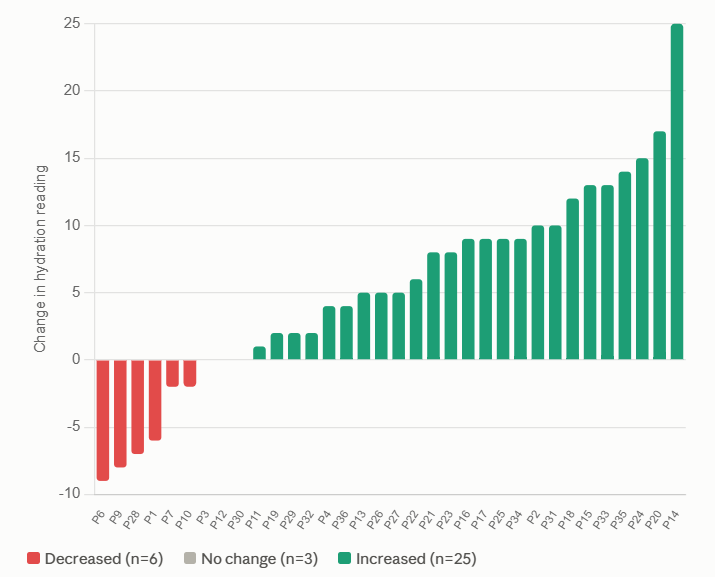
Figure 2. Changes in hydration values of each participate over 28 days of using The Serum
What is Corneometer?
A Corneometer is a device used to measure the hydration level of the stratum corneum, the outermost layer of the skin. It works by sending a weak electrical current through the skin and measuring the resistance, which provides an indication of the skin’s hydration level.
The principle involved in a Corneometer is based on electrical conductance. The device measures the electrical conductance of the stratum corneum, which is directly proportional to the skin’s hydration level. When the skin is hydrated, its electrical conductance increases due to the presence of water molecules that conduct electricity. The Corneometer sends a weak electrical current through the skin and measures the resistance to the current, which is then used to calculate the skin’s hydration level. This measurement is non-invasive and provides a quick and accurate assessment of the skin’s hydration status, See Corneometer: Principle, Working, Applications, Advantages | Pharmacy Infoline for further information.