Dry skin isn’t a single problem. It’s usually one of three things: daily habits stripping the barrier (hot water, harsh cleansers), an irritant actively damaging it, or an age-related decline in the skin’s own water-holding machinery. Treating the wrong one is why “just moisturize more” so often fails.
The Barrier Is the Real Story
Skin’s outer layer holds water using two systems: a lipid matrix (ceramides, cholesterol, fatty acids) that seals moisture in, and Natural Moisturizing Factor (NMF) — amino acids and urea inside skin cells that hold water within them. A drop in ceramide levels is directly linked to dry, barrier-disrupted skin, and
restoring them topically measurably improves both hydration and barrier function [1]. Hot water makes this worse: a controlled clinical study found hot water exposure significantly increased water loss and weakened barrier function compared to cold water [2]. Age adds a third layer — sebaceous gland output declines over time [3], and skin’s water-channel proteins (aquaporins) decrease in expression with age, independent of oil loss [4]
What TARAMAR’s Own Data Shows
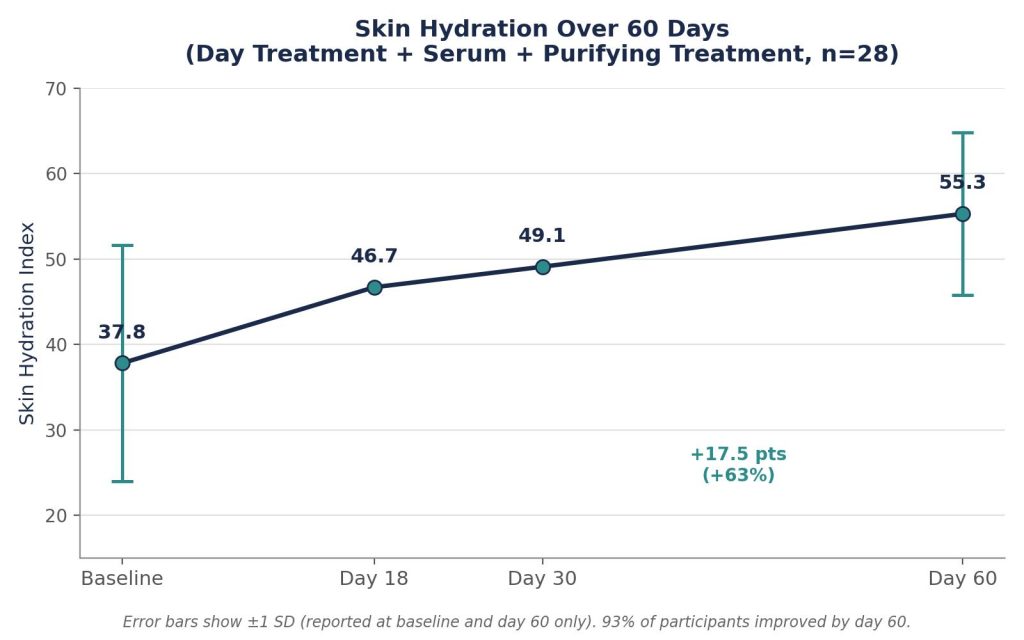
TARAMAR ran a 60-day hydration study on 28 participants using Serum, Day Treatment, and Purifying Treatment, measured with an Italian MicroCamera device. Average hydration rose 63% by day 60, with 93% of participants improving — but the more relevant finding for dry skin specifically is this: baseline hydration was strongly negatively correlated with improvement (r = −0.82). Participants who started driest saw the largest gains, both in absolute and percentage terms. The two non-responders both started with among the highest baseline hydration in the group — consistent with a ceiling effect, not a treatment failure. In practical terms: this routine did the most for the people who needed it most
Why This Design Works for Dry Skin
TARAMAR formulates around barrier repair rather than surface plumping — avoiding the harsh surfactants and synthetic irritants that damage the lipid matrix in the first place, and using liposomal delivery so actives actually reach it rather than sitting on top. For daily support, Serum and Day Treatment are the tested foundation. For more persistent dryness or cold climates, Hydration Treatment is built as the heavier emollient layer worn on top to seal that work in
The Takeaway
The data backs up what the biology predicts: skin that starts driest has the most room to improve, and a routine built around barrier repair — not just short-term hydration — is what gets it there.
Sources
[1] Kono, T., et al. (2021). Clinical significance of the water retention and barrier function-improving
capabilities of ceramide-containing formulations. Journal of Dermatology, 48(11).
[2] Herrero-Fernandez, M., Montero-Vilchez, T., Diaz-Calvillo, P., Romera-Vilchez, M., Buendia
Eisman, A., & Arias-Santiago, S. (2022). Impact of Water Exposure and Temperature Changes on Skin
Barrier Function. Journal of Clinical Medicine, 11(2), 298.
[3] “Aging in the sebaceous gland.” PMC.
[4] “Relationship between Aging-Related Skin Dryness and Aquaporins.”
Also drawing on: TARAMAR 60-Day Hydration Study, Part XII (Product Knowledge Base) — in-house
clinical data.