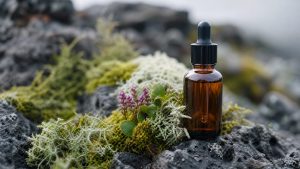
The Glass Is Gorgeous. The Serum Inside Is Suffering.
Why clear packaging can’t protect fragile bioactives, and what actually does
Walk into any beauty store and you’ll see it: rows of crystal-clear glass bottles catching the light, glowing like little jewels. It’s beautiful. It’s also the problem. Every beam of light that makes that bottle sparkle goes straight through it and into the formula.
For a product made of stable, inert ingredients (most often synthetic polymers), that doesn’t matter much. For a formula built on genuine bioactives from plants and seaweed, it matters a great deal.
Bioactives Were Never Meant to Live Alone
In a living plant or seaweed, light-sensitive compounds are never left to fend for themselves. They sit inside cellular structures that are built to handle sunlight. Pigments are anchored in protein complexes within membranes, and those structures channel excess light energy safely away.
Seaweed’s signature pigment, fucoxanthin, is a good example. In the living alga, it sits within protein-pigment complexes that harvest light under water and quench excess energy, giving algae outstanding photoprotection [1]. Photosynthesis researchers studying chlorophyll in these protein complexes proposed energy transfer between pigments as a general protection mechanism against photobleaching [2].
Extraction strips that protective scaffolding away. Once the compound has been removed from the cell, it has to face light on its own. Isolated fucoxanthin deteriorates on contact with light, heat, oxygen, enzymes and other pro-oxidant compounds [3]. The losses can be dramatic. In a study of extracts from the brown seaweed Undaria pinnatifida, the conventional extracts lost around 90% of their initial fucoxanthin content after light exposure [4].
The very compounds that make a seaweed or botanical extract valuable are the ones that need protection most once they leave the plant.
Clear Glass Lets Almost Everything In
Clear glass does very little to stop light. Measurements from packaging research show that clear glass transmits 91% of fluorescent light, compared with only 4% for paperboard [5].
The pharmaceutical world settled this question long ago. Amber glass is the standard for storing light-sensitive drugs, and official pharmacopeia standards set maximum light transmission in the short-wavelength region from 290 to 450 nm before a container can count as light-resistant [6]. Clear glass isn’t designed to meet that standard.
Medicine learned to keep its most fragile molecules in the dark. Much of skincare hasn’t caught up.
How Fast Is Fast? Minutes.
The best-documented real-world example isn’t skincare. It’s milk, a natural liquid full of light-sensitive vitamins that was sold in clear glass bottles for decades and studied closely because of it.
A classic study in The Journal of Nutrition placed milk in ordinary glass bottles in the sun. The destruction of vitamin C was very rapid: little, if any, was left after 30 minutes of exposure [7]. Riboflavin (vitamin B2) held out a little longer, but in a later study of bottled milk, 72.4% was destroyed after one hour of sunlight and 92% after two hours [8]. The chemistry starts early: a review of riboflavin research reports that around 30% of the riboflavin in milk is destroyed within just 30 minutes of sunlight [9].
Skincare actives behave the same way. In one pharmaceutical study of a vitamin A derivative, isotretinoin in solution photodegraded completely within just a few minutes of direct sunlight [10]. Vitamin A compounds are especially vulnerable because their maximum absorbance is around 325 nm, so they efficiently absorb both UVA and UVB radiation [11]. Twenty minutes on a sunny windowsill, a car seat or a café table therefore falls squarely within the window where research shows serious losses. The bottle still looks full and beautiful. The bioactive activity inside may not be
Broken Down Doesn’t Just Mean Weaker
Losing potency is only half the story. When light breaks a bioactive apart, the fragments don’t simply disappear. FDA researchers studying vitamin A compounds found that retinoids absorb UVA light and can generate reactive oxygen species that damage cellular structures and DNA [12].
That means a formula meant to fight oxidative stress can end up adding to it. The ingredient you paid for as an antioxidant may reach your skin as the opposite.
What Actually Protects a Formula
Light-blocking packaging. Opaque or properly light-filtering containers remove the problem at the source. Storing a product in a closed cabinet rather than on a sunny shelf helps too.
Encapsulation. If the cell’s protective structure is lost during extraction, formulation can rebuild some of it. In the isotretinoin study, embedding the active in a microemulsion increased its half-life about five-fold under direct sunlight [10]. The same principle applies to seaweed pigments: fucoxanthin’s stability has been improved with emulsifiers and with encapsulation [3]. This is exactly the area where TARAMAR’s founders have published, including research on keeping β-carotene stable inside solid lipid nanoparticles without synthetic stabilisers [13].
Respect from harvest to shelf. At TARAMAR, we go to great lengths to grow organic, pesticide-free Icelandic herbs and to harvest seaweed from clean Arctic waters. It would make no sense to lose all that care to an afternoon of sunshine through a pretty bottle.
That’s why every TARAMAR product is packed in black glass or very dark violet glass. Instead of putting our formulas on display, the glass shields them from the light that breaks down delicate bioactives. The seaweed and Arctic herbs we work so hard to grow and harvest are dear to us, and we want every drop to reach your skin as active as the day it was made.
The Takeaway
Clear glass sells the look of purity. Real purity means the bioactives are still active when they reach your skin. Natural ingredients spent their whole lives protected by living cells. Once they are extracted, protecting them from light becomes the formulator’s job, and that job starts with the bottle.
References
[1] Büchel, C. (2020). Light harvesting complexes in chlorophyll c-containing algae. Biochimica et Biophysica Acta (BBA) – Bioenergetics, 1861(4), 148027. doi:10.1016/j.bbabio.2019.05.003
[2] Carpentier, R., Leblanc, R., & Bellemare, G. (1986). Chlorophyll photobleaching in pigment-protein complexes. Zeitschrift für Naturforschung C, 41(3), 284–290. doi:10.1515/znc-1986-0307
[3] Kumarasinghe, H., & Gunathilaka, M. (2024). A systematic review of fucoxanthin as a promising bioactive compound in drug development. Phytochemistry Letters, 61, 52–65. doi:10.1016/j.phytol.2024.03.009
[4] Piovan, A., Seraglia, R., Bresin, B., Caniato, R., & Filippini, R. (2013). Fucoxanthin from Undaria pinnatifida: Photostability and coextractive effects. Molecules, 18(6), 6298–6310. doi:10.3390/molecules18066298
[5] Brothersen, C., McMahon, D.J., Legako, J., & Martini, S. (2016). Comparison of milk oxidation by exposure to LED and fluorescent light. Journal of Dairy Science, 99(4), 2537–2544.
[6] United States Pharmacopeia. General Chapters <660> Containers—Glass and <671> Containers—Performance Testing.
[7] Holmes, A.D., & Jones, C.P. (1945). Effect of sunshine upon the ascorbic acid and riboflavin content of milk. The Journal of Nutrition, 29, 201–209.
[8] Paik, J.J., & Kim, H. (1976). Riboflavin in milk and milk products and the destructive effect of sunlight. Korean Journal of Nutrition, 9(2), 54–58.
[9] Sheraz, M.A., Kazi, S.H., Ahmed, S., Anwar, Z., & Ahmad, I. (2014). Photo, thermal and chemical degradation of riboflavin. Beilstein Journal of Organic Chemistry, 10, 1999–2012. doi:10.3762/bjoc.10.208
[10] Patel, M.R., Patel, R.B., Parikh, J.R., & Patel, B.G. (2011). Improving the isotretinoin photostability by incorporating in microemulsion matrix. ISRN Pharmaceutics, 2011, Article 838016. doi:10.5402/2011/838016
[11] Fu, P.P., Xia, Q., Yin, J.J., Cherng, S.H., Yan, J., Mei, N., Chen, T., Boudreau, M.D., Howard, P.C., & Wamer, W.G. (2007). Photodecomposition of vitamin A and photobiological implications for the skin. Photochemistry and Photobiology, 83(2), 409–424. doi:10.1562/2006-10-23-IR-1065
[12] Tolleson, W.H., Cherng, S.H., Xia, Q., Boudreau, M., Yin, J.J., Wamer, W.G., Howard, P.C., Yu, H., & Fu, P.P. (2005). Photodecomposition and phototoxicity of natural retinoids. International Journal of Environmental Research and Public Health, 2(1), 147–155.
[13] Helgason, T., Awad, T.S., Kristbergsson, K., Decker, E.A., McClements, D.J., & Weiss, J. (2009). Impact of surfactant properties on oxidative stability of β-carotene encapsulated within solid lipid nanoparticles. Journal of Agricultural and Food Chemistry, 57(17), 8033–8040. doi:10.1021/jf901682m