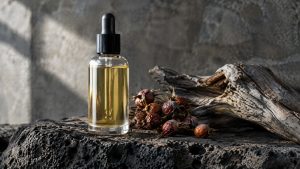
Most oils that claim to be “lightweight” still leave a trace — a faint film, a slight shine that lingers longer than you’d like. When we were building Hydration Treatment, that wasn’t good enough. We wanted an oil that could sink in completely, disappear into the skin, and still do real work once it got there. That search led us to a small, unglamorous seed most people only associate with bagels: poppy.
A Quiet Ingredient With an Unusually High-Performing Profile
Our poppy seed oil used in the Hydration Treatment is harvested in north England — virgin, cold-pressed, non-GMO. Nothing exotic about the source; the reason it earned its place in the formula is entirely in the chemistry.
Poppy seed oil is dominated by linoleic acid, an omega-6 polyunsaturated fatty acid that typically makes up 60–70% of the oil — one of the highest linoleic acid contents of any common carrier oil, higher than grapeseed or sunflower. That’s not a small distinction. Linoleic acid is the fatty acid your own skin barrier is built from, and it’s also the fatty acid that determines how an oil feels and behaves on skin.
Why “Light” Actually Matters
A facial oil that sits on the surface isn’t doing much except making skin look shiny. We wanted the opposite: something that could disappear into skin fast enough to layer under other products without ever feeling heavy. Poppy seed oil’s high linoleic acid content is exactly why it behaves this way — linoleic-acid-rich oils are naturally thin and fast-absorbing, in contrast to the thicker, heavier feel of oleic-acid-dominant oils like olive or avocado. That’s the difference between an oil that becomes part of your daily routine and one you only reach for occasionally, when your skin can tolerate the weight.
The Part That Actually Repairs Skin
Texture is only half the story. Linoleic acid is also one of the most well-documented fatty acids for skin barrier repair — it’s a structural building block of the ceramides that hold the outer skin layer together, and topical research has repeatedly linked it to reduced transepidermal water loss and a more resilient barrier overall. In one clinical trial on atopic, barrier-compromised skin, a linoleic-acid-based formula performed on par with a standard barrier treatment over four weeks. Separate research has connected linoleic acid to measurable anti-inflammatory effects on skin — exactly the profile we needed for a blend meant to calm reactive, compromised skin, not just hydrate it.
As an emollient, poppy seed oil fills in the microscopic gaps between skin cells, smoothing the surface and slowing water loss — without the heavy film that comes from thicker, more occlusive oils. That makes it something you can use daily, on any skin type, without worrying about clogged pores or a greasy finish.
More Than Fatty Acids: The Vitamin E and Plant Sterols Riding Along
Linoleic acid isn’t the only reason this oil earns its place in the formula. Poppy seed oil also carries a meaningful natural vitamin E content — predominantly gamma-tocopherol, with smaller amounts of alpha-tocopherol alongside it. Vitamin E is one of the skin’s own natural antioxidants, and applied topically it helps neutralize the free radicals generated by everyday UV and environmental exposure — the same kind of oxidative stress that gradually wears down collagen and elastin over time.
There’s a quieter benefit here too: that same vitamin E helps protect the oil’s own linoleic acid from oxidizing before it ever reaches your skin, which is part of why a well-sourced poppy seed oil stays stable rather than turning rancid the way many polyunsaturated oils tend to.
Alongside the vitamin E, poppy seed oil contains plant sterols — naturally occurring compounds structurally similar to the lipids already found in skin. These sterols are increasingly recognized in cosmetic formulation for supporting the same barrier function that linoleic acid works on, reinforcing the skin’s lipid matrix from a slightly different angle. Between the fatty acids, the tocopherols, and the sterols, poppy seed oil isn’t a one-note ingredient — it’s a small, coordinated nutrient profile that happens to come from a single seed.
A Calming Partnership
In Hydration Treatment, poppy seed oil doesn’t work alone. Paired with mangosteen oil, its high linoleic acid content — reinforced by its own vitamin E and plant sterols — plays a central role in the blend’s ability to visibly calm redness and disturbed skin. It’s two lightweight, barrier-supportive oils doing quiet structural work together, rather than one heavy oil trying to do everything at once.
The Takeaway
Poppy seed oil isn’t a flashy ingredient. It doesn’t come with a dramatic origin story or an exotic harvest. What it offers instead is exactly what a daily hydration formula needs: fast absorption, a barrier-repairing fatty acid profile, natural antioxidant protection from its own vitamin E, and a calming effect that holds up under real skin stress — all without ever feeling heavy. That’s the quiet logic behind why it’s in Hydration Treatment, and why it stays there.
Sources
Satransky, M., Fraňková, A., Kuchtová, P., Pazderů, K., & Capouchová, I. (2021). Oil content and fatty acid profile of selected poppy (Papaver somniferum L.) landraces and modern cultivars. Plant, Soil and Environment, 67(10), 579–587 — linoleic acid content of 71–74% across evaluated poppy genotypes.
Erinç, H., Tekin, A., & Özcan, M.M. (2009). Determination of fatty acid, tocopherol and phytosterol contents of the oils of various poppy (Papaver somniferum L.) seeds — gamma- and alpha-tocopherol content and total sterol levels across poppy seed oil samples.
Danby, S.G., et al. Topical linoleic acid vs. urea in atopic dermatitis — randomized, intra-individual split-body trial comparing barrier-repair efficacy.